Updated September 4, 2026 · By @willing_ye
How to Add a Manual Mask When Face Detection Misses a Face
If automatic coverage misses a face or stops too early, add a manual rectangle. For a repeatable walkthrough, we deliberately ignore the right-hand person’s detected track in the two-person sample. The uncovered face below is a constructed demonstration, not a claim that YuNet missed that frame.
Open FaceMasks →Real operation screenshots from the Simplified Chinese interface. Click an image to view it at full size. These are preview screenshots, not a guarantee of coverage across the video.
1. Find the uncovered interval
In your own video, pause on an uncovered face and inspect neighbouring frames to find where coverage first becomes insufficient and when it recovers. For this exercise, process the sample and ignore track #1 as shown in the selected-face tutorial. Return the timeline to 00:00.00.
2. Set a short time range
Open Manual masks. Enter 0 for Start (seconds) and 0.5 for End (seconds). These values belong to this exercise, not to every missed face. A valid end time must be later than the start time.
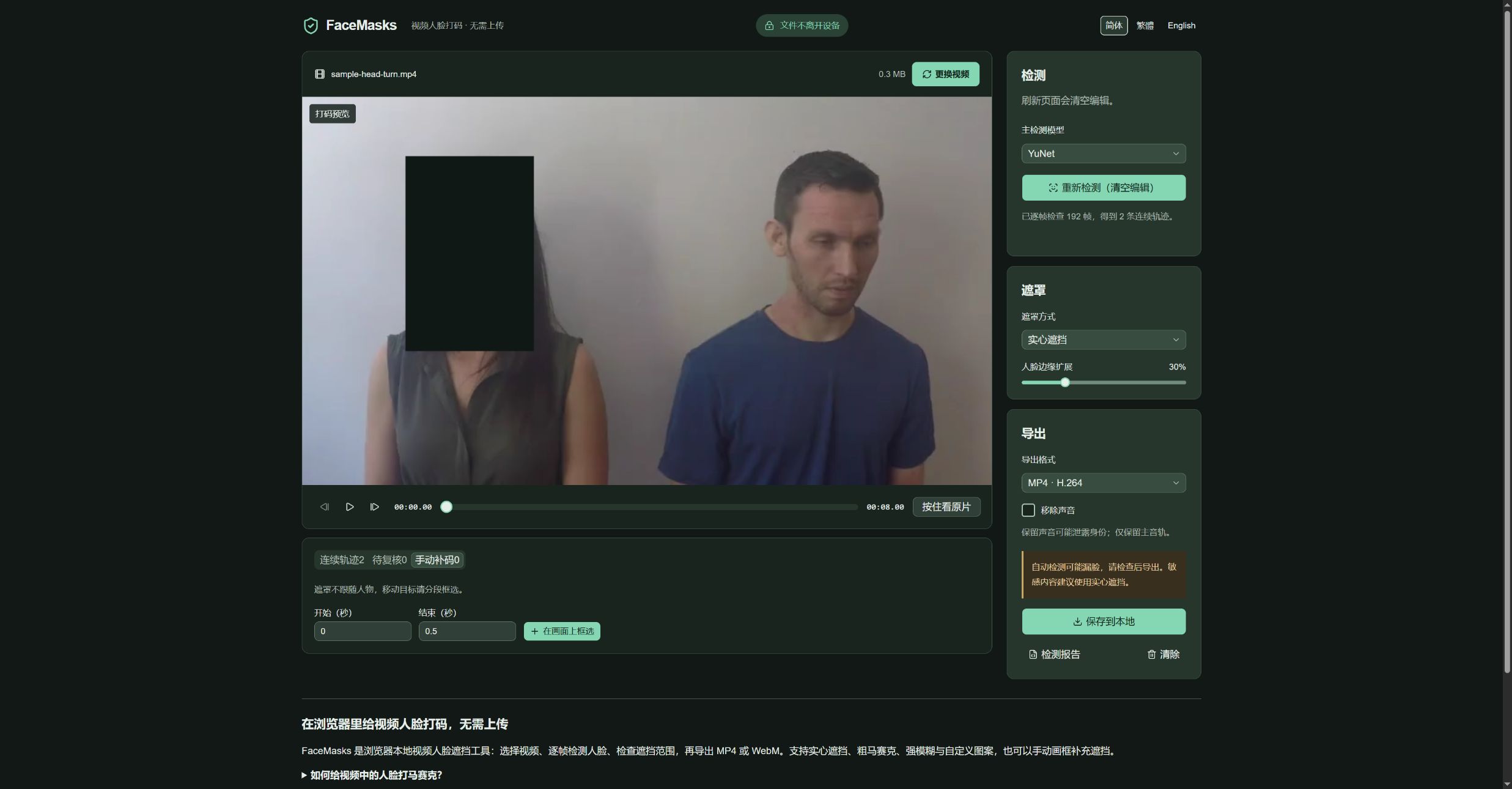
3. Draw over the face
Click Draw on the video, then drag a rectangle around the exposed face in the preview, leaving enough margin. Releasing the pointer adds the mask. The manual-mask tab now shows one item and its time interval.
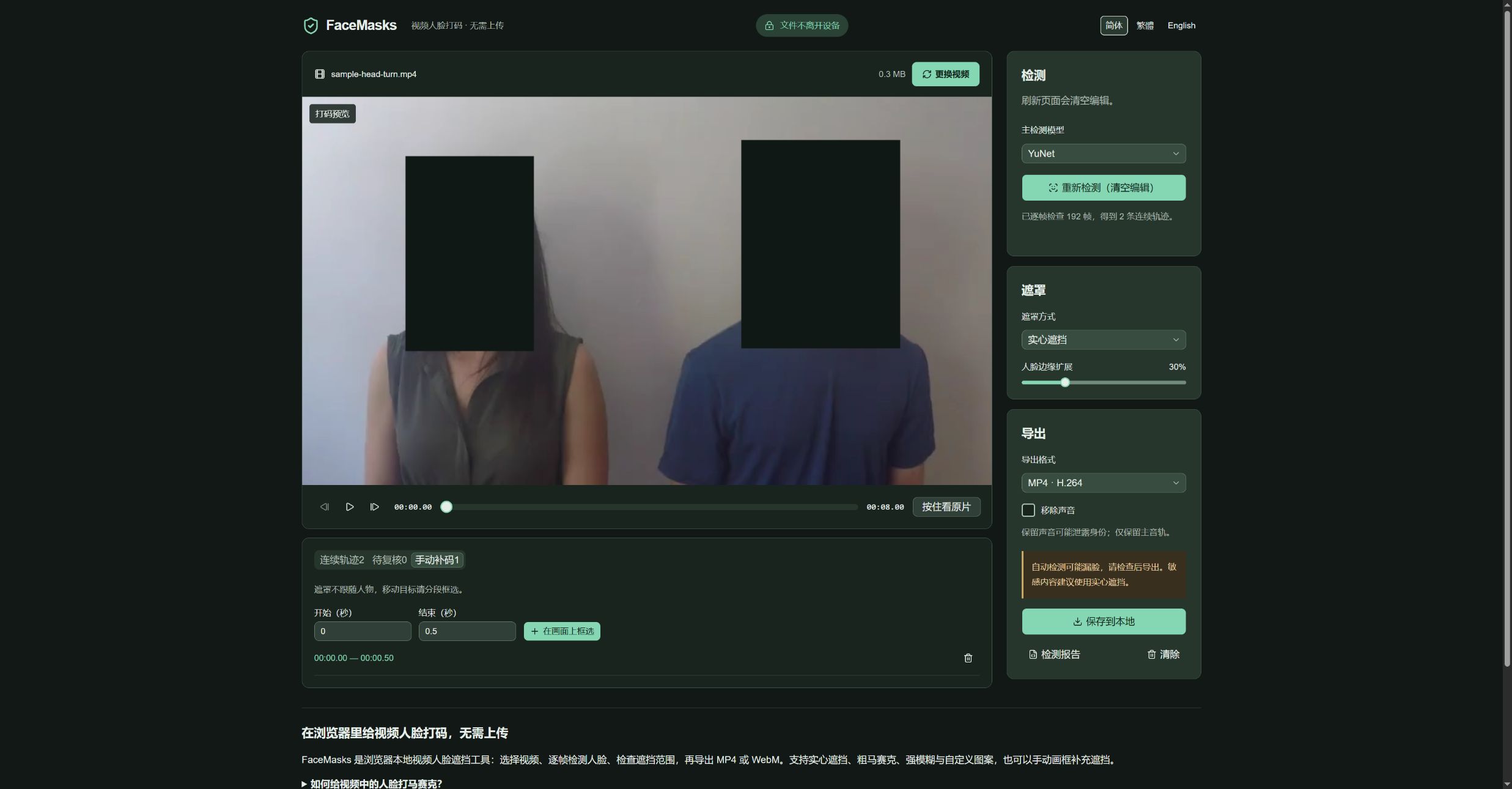
4. Check motion and both boundaries
Step through the interval and the frames immediately before and after it. A manual rectangle does not move with a face. For a moving target, delete an unsuitable rectangle and add shorter, overlapping time segments with suitable positions. This half-second exercise does not cover the remainder of the ignored eight-second track: restore that automatic track or finish all required manual segments before exporting.
Demo source: Intel sample-videos, head-pose-face-detection-female-and-male.mp4, CC BY 4.0. The 8-second sample was trimmed, accelerated 2× and muted; these screenshots show FaceMasks preview modifications. No endorsement is implied. Source · CC BY 4.0 · Credits